FLUID ANALYSIS
· TBW · ECF · ICF
· Hy-Dex® Hydration Analysis
Beneath the surface lie the most telling changes in the body. The SOZO® Digital Health Platform uses bioimpedence spectroscopy (BIS) to bring them into view, with measurable insight into fluid status, cellular health, and tissue composition. From a single non-invasive, rapid scan, health professionals can see what’s changing, track it over time, and act on it with confidence.

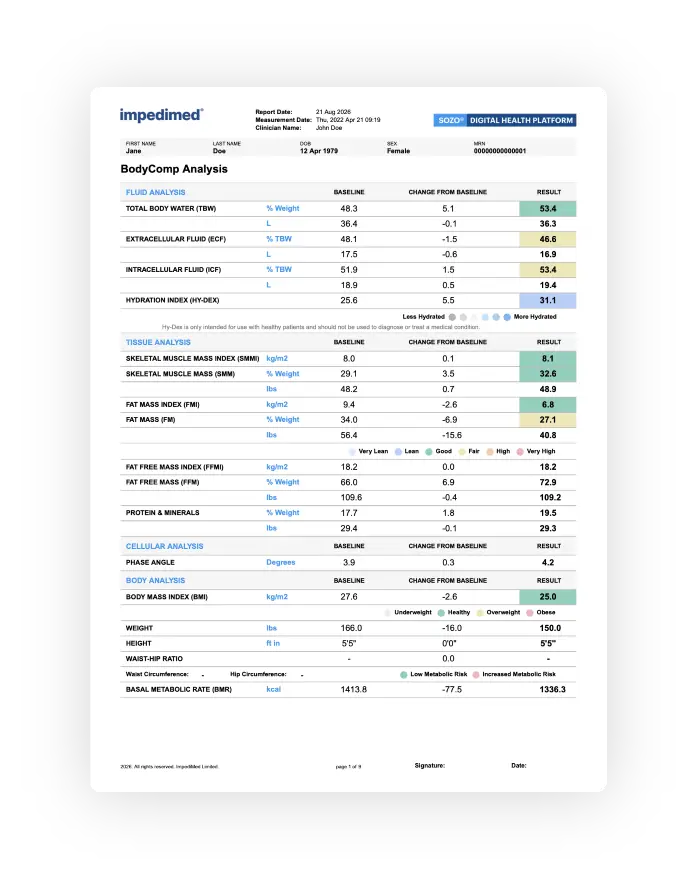
The SOZO Digital Health Platform with BodyComp Analysis is the only FDA-cleared BIS solution for body composition assessment in both healthy and unhealthy populations, providing comprehensive insights beyond BMI and weight to assess what is truly changing inside the body:

· TBW · ECF · ICF
· Hy-Dex® Hydration Analysis

· SMM · SMMI · FM · FMI
· FFM · FFMI · ASMM
· Protein & Minerals

· Phase Angle

· BMR · BMI
· Segmental Analysis
A single measurement is a snapshot. Tracked over time, it becomes a story, helping health professionals see how fluid, muscle, and fat shift with treatment or lifestyle change, and act sooner when it matters most.
Bioimpedance analysis (BIA) and bioimpedance spectroscopy (BIS) are both non-invasive technologies that estimate body composition by measuring how the body conducts electrical current — but they differ fundamentally in how they do it, and those differences have meaningful consequences for clinical accuracy.
Standard BIA operates at a single fixed frequency, or at a small number of frequencies, which limits its ability to separate extracellular fluid from intracellular fluid or fully penetrate cell membranes. To compensate for this limitation, single-frequency BIA devices rely on population-based prediction equations to estimate fat mass, lean mass, and fluid volumes. This introduces meaningful error when applied to individual patients who differ from the reference population, such as those who are elderly, obese, managing chronic illness, or undergoing treatments like cancer therapy or GLP-1 medications that alter fluid distribution.
Bioimpedance spectroscopy (BIS) takes a fundamentally different approach. By measuring electrical resistance and reactance across a broad spectrum of frequencies — ImpediMed’s SOZO® platform uses 256 frequencies up to 1,000 kHz — BIS derives fluid and tissue measurements directly from each individual’s own biological data, without relying on population averages. This enables accurate, independent measurement of extracellular fluid, intracellular fluid, skeletal muscle mass, and fat mass in a single 30-second scan. ImpediMed’s BIS technology has been validated against gold standard methods including deuterium oxide dilution and dual-energy X-ray absorptiometry (DXA). For clinical applications where individual-level precision matters — such as monitoring muscle preservation during weight loss, detecting fluid changes in heart failure, or tracking body composition through cancer survivorship — BIS delivers a meaningfully higher standard of accuracy than standard BIA.
Phase angle is a measurement derived from bioimpedance analysis that serves as a direct indicator of cellular health and integrity. When an electrical current passes through the body, it encounters two types of opposition: resistance (from fluids) and reactance (from cell membranes). Phase angle is the relationship between these two forces — specifically, the degree to which cell membranes are able to store electrical charge and resist the passage of current. A higher phase angle indicates cell membranes that are intact, well-hydrated, and functioning normally. A lower phase angle reflects compromised cell membrane integrity, reduced cellular hydration, or loss of metabolically active tissue — all of which are associated with poorer health status and clinical outcomes.
Research across a wide range of clinical populations has established phase angle as a meaningful prognostic marker. Low phase angle has been associated with malnutrition, sarcopenia (age-related muscle loss), frailty, poorer surgical outcomes, reduced quality of life, and increased mortality risk in conditions including cancer, chronic kidney disease, heart failure, and HIV. In oncology specifically, phase angle has been studied as an indicator of nutritional status and functional reserve in cancer patients, where it can help identify patients at risk of poor treatment tolerance before symptoms become apparent.
ImpediMed’s SOZO® BodyComp™ Analysis reports phase angle alongside fat mass, lean mass, skeletal muscle mass, and fluid volumes, giving clinicians a complete picture of both body composition and underlying cellular health in a single non-invasive 30-second scan. Because BIS technology measures across 256 frequencies, it captures the full bioelectrical profile needed to derive a precise and reproducible phase angle reading — making it a reliable metric for longitudinal monitoring in clinical populations where tracking cellular health over time is essential to personalized care.
Body weight is largely water. In a healthy adult, total body water (TBW) accounts for roughly 50–60% of body weight — and the distribution of that water between the body’s fluid compartments is one of the most sensitive and clinically informative indicators of physiological status available. Yet standard body composition assessments, and certainly weight monitoring alone, provide no insight into fluid distribution whatsoever. Understanding not just how much fluid a patient carries, but where that fluid is and how it is shifting over time, opens a dimension of clinical visibility that is simply unavailable from the scale or BMI.
Beyond measuring each compartment in isolation, the ratio of extracellular to total body fluid provides a particularly powerful clinical signal. In a healthy individual, ECF represents approximately 40–42% of total body water. As this ratio rises — meaning a greater proportion of body water is sitting outside cells rather than inside them — it reflects a shift away from lean, metabolically active tissue toward a state of cellular compromise, inflammation, or fluid overload. Tracking this ratio longitudinally on the SOZO® platform gives clinicians a sensitive, individual-level metric that captures physiological deterioration or improvement with greater precision than any single compartment measurement alone.
A single body composition measurement provides a useful snapshot, but its clinical value is limited — it tells you where a patient is, not where they are going. Longitudinal body composition tracking, by contrast, transforms each individual measurement into a data point on a trajectory, enabling clinicians to detect meaningful trends, evaluate whether interventions are working, and intervene early when the body is moving in the wrong direction before that change becomes clinically significant or symptomatic.
Many of the most clinically important changes in body composition are gradual and invisible to routine monitoring. A patient on a GLP-1 medication may be losing weight consistently week over week while simultaneously losing skeletal muscle mass — a shift that carries long-term metabolic and functional consequences but registers as nothing but success on a scale. A cancer survivor may be gaining fat mass and losing lean mass at stable body weight, increasing their risk of recurrence and reducing quality of life, with no outward sign of change. In each of these cases, serial BodyComp™ Analysis measurements create a longitudinal record that makes these otherwise hidden trends visible and actionable, allowing clinicians to intervene sooner to support better patient outcomes.